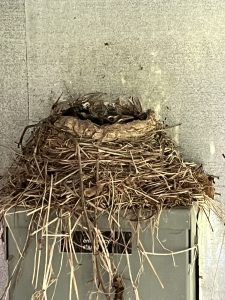
Goodness it’s been hot. What did you have out for birds in your backyard to beat the heat? We have multiple types of cover (shade and safety) and water as well. These robins used the roof of one our sheds as their shade.

where natural history meets art
Goodness it’s been hot. What did you have out for birds in your backyard to beat the heat? We have multiple types of cover (shade and safety) and water as well. These robins used the roof of one our sheds as their shade.

We had some great Early Bird Walks this month—you can visit our checklists at eBird to see what we observed not from the window (link below).
By the end of the month, it felt like things are settling down : a robin is incubating or raising a second brood near our back door; adult cardinals are feeding young. Who next will bring their babies around? Chickadees? Blue Jays? Hummingbirds? Watch for fluttering wings and listen for unusual squeakings.
 Have you been on one of our Early Birder walks yet? Every Sunday in May and June!
Also, wow was it rainy this month. Good heavens.

As usual, we keep track of birds seen through the window with notes on a white board by the window (see the list below). We had a couple of less-usual species sighted this month, including both year-round residents (just not usually observed from the window) and migratory species.
Spring is surely happening!
 As usual, we keep track of birds seen through the window with notes on a white board (see the list below). This month, we also had a lovely furry special guest…

Many thanks to the MP and MP, two regular volunteers with the same initials, who help us participate in community science programs. They have been here almost every Tuesday to record birds for Feederwatch and eBird… and to note birds on the white board by the window (see the list below).
When you go birding, take note of your observations! Every record you contribute is part of important community science and large data monitoring for conservation! One record at a time may not feel like much, but they add up into incredibly useful data. You might enjoy reading “9 Ways People Have Used eBird Data to Make Conservation Happen.” (Ed. note: Let me know of more recent conservation successes based on bird data, and I’ll add that info to next month’s post!)
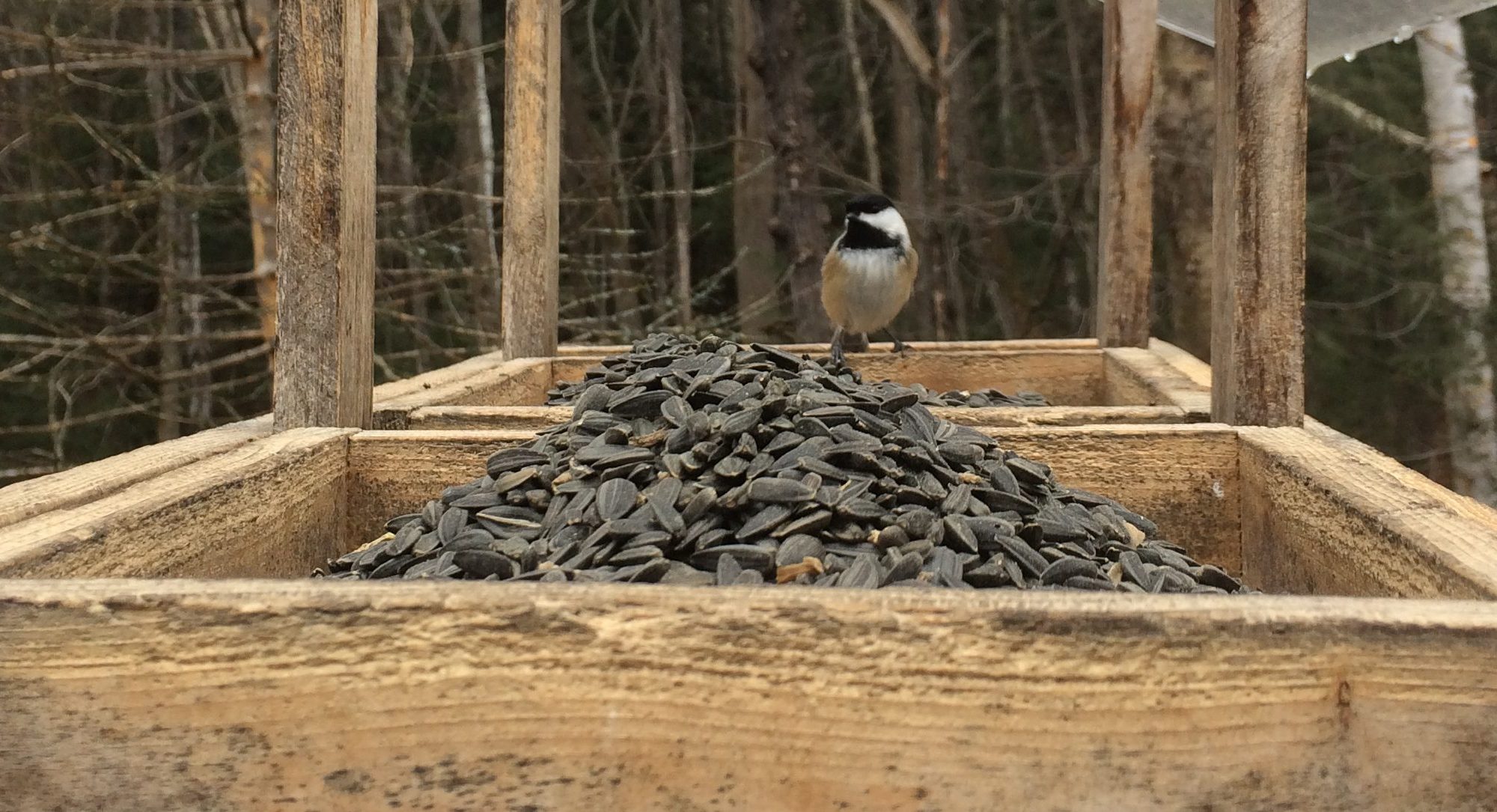
Visit us February 15th, 2025, to see what birds we’re counting for the Great Backyard Bird Count!
We’re open from 10-4 on Saturday for the GBBC
Members admission: Free!
Friday – Monday, February 14-17, 2025 • All Over the World
From the Great Backyard Bird Count website:
Launched in 1998 by the Cornell Lab of Ornithology and National Audubon Society, the Great Backyard Bird Count was the first online citizen-science project to collect data on wild birds and to display results in near real-time.
Since then, more than 100,000 people of all ages and walks of life have joined the four-day count each February to create an annual snapshot of the distribution and abundance of birds.
For more info visit Great Backyard Bird Count website

Friday – Monday, February 14-17, 2025 • All Over the World
Whether you are with a friend or on your own, watching one bird or counting hundreds, join a worldwide community-science and conservation project! All you have to do is observe for 15 minutes and submit your observation(s). Here are few details from https://www.birdcount.org/participate/ :
Step 1 – Decide where you will watch birds. [Suggestion: at the Museum on Saturday!]
Step 2 – Watch birds for 15 minutes or more, at least once over the four days, February 14-17, 2025.
Step 3 – Count all the birds you see or hear within your planned time/location and use the best tool for sharing your bird sightings:
For more info visit https://www.birdcount.org/

December is often a month of vacations and fewer observations. It’s also a properly winter month (usually), which means our birds lists can be a bit shorter than usual. But enjoy the year-round residents with us!
