The Bird Carver’s Daughter (Part 12: My Father and the Speedboat)

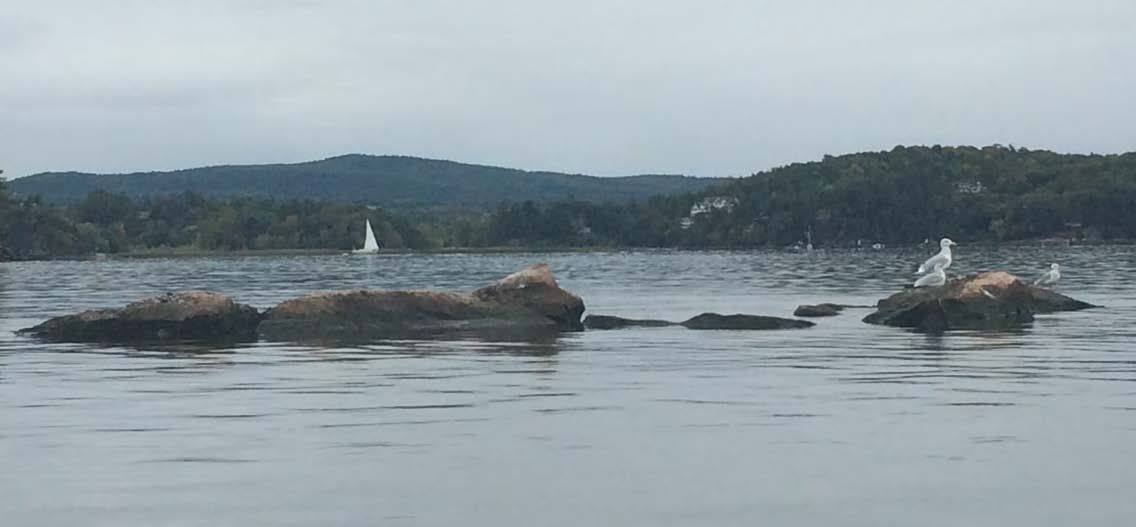
Infamous Speedboat-eating Rocks in Lake Champlain

Guest post by Kari Jo Spear, Photographer, Novelist, and Daughter of Bob Spear
This post appeared first in our Fall Spring 2016  issue of
Chip Notes.
Reprinted by permission.

One family story from before I was born has always haunted me. I could never get my head around the fact that my quiet, slow-moving father had once owned a speedboat and raced around Lake Champlain in it. But as to why he no longer owned it by the time I was old enough to remember has become part of the mists of the past.

When I asked him, all he would say was, “I hit a rock.” End of discussion. End, I assumed, of the speedboat. This helps explain why my father never had anything good to say about the smelly, gas-wasting, pollution-causing, noisemakers that went so fast you couldn’t tell a ring-billed from a herring gull.

My mother didn’t like to talk about the rock and boat incident much either, but her version was more detailed than his. According to her, it happened one summer evening in Malletts Bay, near my family’s camp. She, my father, my uncle Frank, my grandmother, and one of my great aunts were out in the boat, enjoying the sunset. The 1950’s style boat was made of dark wood and had two bench seats running across the middle with a steering wheel in the front. My father was operating it.

Suddenly, according to my mother, there was a jolt. The boat’s speed and direction didn’t change. The boat just no longer had a bottom. She could see the water rushing by below her feet, as if the floor had been peeled away by a giant can opener. She said my father looked down, killed the engine, and the boat promptly sank out from under them.

Yup, hit a rock.

Fortunately, no one was hurt. Someone rescued them from the water as it was getting dark and returned them, tired and wet, to camp. The waiting relatives had become frantic, knowing that something had happened, but not what.

Recently, I emailed my uncle Frank, who now lives in Nevada, to see what he remembered about the accident. He gave me the most detailed account I’d heard about what he called The Great Boat Wreck Caper. He described a late afternoon ride in the family’s new boat along the shore of the bay, where they had slowed down to look at the trees and cliffs. (I suspect there might have been “looking for cliff swallows” too, but that’s just speculation.) Then,he said,

“Bob, who was driving, picked up speed, and as we hit full speed we hit the submerged rock or ledge. After a few seconds of bewilderment, we looked down and saw the water pouring into the boat through a large gash in the bottom. It quickly became evident that we couldn’t stay in the boat, so we abandoned ship.”

The boat sank by the stern, looking “exactly like the pictures of ships that had been torpedoed.” But it didn’t, as the other stories had implied, go straight to the bottom. It remained floating with the bow just above the surface. The survivors weren’t picked up immediately by a rescue boat. They actually swam back and stood on the guilty iceberg (I mean, rock) while someone on shore launched a boat and came out to them. (I am sorely tempted to make a comment about a flock of gulls vying for positions, but I won’t.) Once they were aboard, the rescuer towed the disabled boat to the nearest beach, where they removed the motor. Then the rescuer returned the bedraggled shipwreck survivors, along with the motor, back to camp. My uncle stayed up late disassembling and drying it.

My uncle went on to write, “The next morning, Bob woke me up early so we could take his canoe back to where we had beached the boat. We hooked a line to it and towed it back to camp.” (I sense this might have been the moment when the canoe rose to the top of my father’s list of worthwhile boats.) Then he and my uncle returned (again by canoe) to the site of the disaster one last time to dive for loose articles that had fallen out of the boat, including my uncle’s wallet, which had gone spiraling down to the bottom of the lake like the Heart of the Ocean. (Yes, he found it, along with his car keys, still in the pocket of a pair of pants he’d thrown in the boat at the last minute.)

My uncle finished with, “Over the next few days Bob worked out that we could screw a plywood patch into the hole in the bottom and cover it with fiberglass. It didn’t look great but it worked fine so we were back in business.” (Add speedboat repair to my father’s resume.) Still, I infer that the family’s interest in speedboats had ebbed, and my uncle told me that the boat was sold a few years later.

But even though my father didn’t talk about those days much, I can remember him pointing to a marker on the map of the lake that hung on the camp wall. The mark denoted a dangerous shallow spot in the middle of otherwise deep water. My father smiled a little and said, “Yep, I found that one.”

Like my father, I have chosen quiet, reflective paddling over speed. A few weeks ago, I paddled my trusty kayak deeper into Malletts Bay than I’d ever gone before. The lake level was at a near record low. As I came around a point of land, I saw a dark ledge of rock breaking the surface. Next to it was a white buoy with the word “DANGER” in red on the side. And I realized what I must be looking at. The infamous rock ledge that had torpedoed my father’s boat was actually above surface for the first time in years.

I paddled around it and photographed it with my cell phone. Then I just drifted a while and listened to the gurgle of water and the cries of the gulls, and looked deep into the reflections on the water’s surface.

Infamous Speedboat-eating Rocks in Lake Champlain


Kari Jo Spear‘s young adult, urban fantasy/romance novels are available at Phoenix Books (in Essex and Burlington, Vermont), and on-line at Amazon and Barnes and Noble

Previous posts in this series:
Part 1: The Early Years
Part 2: The Pre-teen Years (or, Why I’m Not a Carver)
Part 3: Something’s Going On Here
Part 4: The Summer of Pies
Part 5: My Addiction
Part 6: Habitat Shots
Part 7: Growing Up
Part 8: My Dead Arm
Part 9: Remembrance: Tales of My Father
Part 10: Canoe Lessons
Part 11: Battlefields


Our Annual Appeal for 2016

Thank you and Happy Holiday Season
from the Birds of Vermont Museum

There’s still time to make a tax-deductible donation to the Museum for 2016!
Please consider sending a contribution during our year-end appeal
—whether $1 or $5000— we happily accept donations online through JustGive, NetworkForGood, and PayPal. You can also call (802) 434-2167 with your credit card info, or send a check in any amount at any time to

Donate to the Birds of Vermont Museum! Your gift is tax-deductible.
 
Birds of Vermont Museum
900 Sherman Hollow Road
Huntington, Vermont 05462

Donate to the Birds of Vermont Museum with Network for Good! Your gift is tax-deductible.

We welcome your support in any and every form: Continue reading “Our Annual Appeal for 2016”

Call to Artists: Birding By the Numbers

Birding by the Numbers

A Call to Artists from the Birds of Vermont Museum in celebration of our 30th Anniversary

We at the Museum like to say we are “where natural history meets art.” But flip through the files of time while birding in the last 30 years… what would ornithology be without math? What new facts and figures about feathered phenomena do you most appreciate? Join us as we play with birds and numbers!

We seek bird-focused art that incorporates a feeling for number with artistic expression. We are open to any media. Let your art—from imaginary to irrational, with birds silly and significant—populate our creative space!

Here is a tiny fraction of funky factoids to tickle your fancy and perhaps illustrate what we mean: Continue reading “Call to Artists: Birding By the Numbers”

The Bird Carver’s Daughter (Part 11: Battlefields)

Guest post by Kari Jo Spear, Photographer, Novelist, and Daughter of Bob Spear
This post appeared first in our Spring 2016  issue of
Chip Notes.

Reprinted by permission. Links added by K Talmage, Museum blog editor.

If birds were my father’s first passion, the Civil War was his second. (Family, he pretty much took for granted.) He could fight every battle from memory, including all the skirmishes leading up to it as well as the aftermath, and discuss the finer points of each battle’s contribution to the overall picture and its enduring legacies. He focused on the Vermonters, especially his great-grand-father and hero, Alonzo Spear. Yet he always held Robert E. Lee in the highest regard. For a long time, I could never understand why my peace-loving, crowd-hating, and squeamish father had such a fascination for battlefields. When I asked him, all he would say was, “Well, they’re kind of interesting.”

One day, my father, Gale, and I visited the Hubbardton Battle Field, where Vermont’s only Revolutionary War battle had taken place. None of us had ever been there before. In the visitor center was a diorama depicting the various movements of the troops during the engagement. I remember standing there, feeling baffled. My father silently contemplated the scenario for a few moments and then launched into a full explanation. He waved his hands over the diorama like a conductor, commenting on the initial positions of both sides, the strategic fallbacks, the flanking attempts, and the outcome. (We lost. But we Vermonters achieved our goal of halting the British in their tracks long enough to allow the main American force to get away. See, I was listening.)

Unbeknownst to us, a member of the staff had been listening, too. “You must be a scholar of this aspect of the Revolution,” he said to my father.

My father shook his head. “Not really. But it’s kind of interesting.”

When we got outside, I said, “I thought you’d never been here before.”

“I haven’t. But these battles are really simple compared to the Civil War.” In other words, he’d figured the whole thing out in about a minute.

My father really was a scholar of the Civil War. I don’t think there is any book, article, or movie he hadn’t memorized. About the only reason he’d leave the museum for a vacation was to tour a battlefield. He visited all the major ones, figuring out exactly where Alonzo would have been standing. Poor Gale would often say with a sigh, “We’re off to fight the Civil War again.” So much for tropical vacations.

This year, one of the high school classes where I assist students did an in-depth study of the Civil War. We read, watched documentaries, and listened to speakers. During class reading time, I found myself researching the 2nd Vermont. When I watched the documentaries, I tried to figure out where my great-great grandfather had been standing. (Yes, he was in the thick of things at Gettysburg, one of the heroic Vermonters who had saved the day and perhaps even turned the tide of the war.) I kept reading more and more. It was addictive. And ancestral.

We spent a lot of time focusing on the military genius of Robert E. Lee. And finally, I began to understand why my father had been so fascinated. Like Lee, my father was a man who planned ahead in a logical way, who studied the lay of the land, who had an instinct for the weather, who knew how to use the sunlight to best advantage, and who had an intuitive sense of how much men and horses could take.

General Spear. It would have been … interesting.

One day, as I headed for my next class with my students, I hesitated for a moment. I almost thought I’d heard my father’s voice echoing down the halls. “Forward, march!”


Kari Jo Spear‘s young adult, urban fantasy novels, Under the Willow, and  Silent One, are available at Phoenix Books (in Essex and Burlington, Vermont), and on-line at Amazon and Barnes and Noble

Previous posts in this series:
Part 1: The Early Years
Part 2: The Pre-teen Years (or, Why I’m Not a Carver)
Part 3: Something’s Going On Here
Part 4: The Summer of Pies
Part 5: My Addiction
Part 6: Habitat Shots
Part 7: Growing Up
Part 8: My Dead Arm
Part 9: Remembrance: Tales of My Father
Part 10: Canoe Lessons


Woodcocks and Owls

Guest post by our friend and expert birder, AW.

Sunday evening, following a spring time ritual, I walked from Moody Road to Maple Drive at dusk in hopes of hearing American Woodcocks and seeing their flight display. Mid-March is when they start to come back to their breeding territories. I did not find any evidence of them this time, but I was surprised to hear another bird calling from the woods west of the Huntington River and the Camel’s Hump Alpaca farm fields. In the 10+ years I’ve been walking this route, it was only the second time I’ve heard a Northern Saw Whet tooting persistently from the woods. February 14, 2012 was the other time I heard one in nearly the same place, leaving me to wonder if it is a resident bird! Nice!

“In Layers: The Art of the Egg ”: Call to Artists from the Birds of Vermont Museum

Be part of our 2016 eggs-hibition! Do you create? Do you have a thing for birds, science, or conservation? We do too.

The Birds of Vermont Museum seeks art and craft that focus on the beauty, biology, and essence of eggs for our 2016 season Art Exhibit, In Layers: The Art of the Egg. We’re hoping to hatch feelings of passion, delight, commitment, and discovery with this art (watch for additional activities and displays about oology during the season as well).

The show runs from May 1 to October 31 in the Museum’s multi-purpose room, halls, and foyer. Most art will be hung on the walls. We have shelf space for three-dimensional works and some ceiling space if your work is suitable there. Feel free to visit and scope out the options! We are open to all sorts of media and we strive, in choosing works, for a harmonious variety. Continue reading ““In Layers: The Art of the Egg ”: Call to Artists from the Birds of Vermont Museum”

The Bird Carver’s Daughter (Part 10: Canoe Lessons)

Guest post by Kari Jo Spear, Photographer, Novelist, and Daughter of Bob Spear
This post appeared first in our Late Fall 2015  issue of
Chip Notes.

Reprinted by permission.

In one thing, my father and I were always in perfect accord. He may have dragged me kicking and screaming into the world of birding, but I always loved to canoe. From the time I was old enough to reach over the gunwale, I had a paddle in my hands. My first one was a blue plastic badminton racquet attached to a thwart with a string. I paddled my little heart out with it, stirring up white water and getting soaking wet while my father paddled serenely along in the stern. I always wondered why everybody laughed when they saw us coming.

When I was old enough to graduate to a wooden paddle, my father had me sit in the bow. I’d hardly learned the basic strokes when he put me in the stern and took the bow himself.

“Wait, this is where you steer from,” I said.

“Yeah,” he said and demonstrated the J-stroke.

Surprisingly, it was really easy to make the canoe go where I wanted it to, unlike riding a bike, or doing math. My father preferred to hug the shoreline (watching for shorebirds wasn’t enough for him—he wanted to see warblers, too.) I ran him into a few low hanging limbs at first, but he didn’t mind, even when they had spiders (which always seemed to find their way back along the length of the canoe to my bare toes).

Soon he began giving me complex directions like, “Bring us in sideways next to that log. Back up a little. Hold it right there.” It took me a while to notice he wasn’t paddling—he was looking through his binoculars into the trees. Huh.

Once I got really good at steering, he taught me how to paddle without taking the paddle out of the water. “It’s the way the Indians used to do it,” he said. “You don’t make any noise at all. Take a regular stroke and then sort of glide the paddle up ahead of you through the water, angled a little. That’s it.”

My paddle slid through the water like a silent knife, completely eliminating the plunk of the blade breaking the surface and the silvery rain of drops coming off the edge when it swept forward. I imagined Indians sneaking up on their enemies, soundless in the night.

“Works great to get close to a heron,” my father said.

That, too.

The first time I ever paddled solo was on a field trip. There were seven or eight canoes, and we spent the day making our way down Otter Creek. We had spotted a car where we planned to take out. The problem was we couldn’t see the road from the creek. By late afternoon, everyone was tired, hot, hungry, sunburned, bug bitten, sick of sitting, and had to pee (at least, I did). But we couldn’t find the car. A discussion broke out over whether we’d passed it, or if it was still ahead. My father told everybody to rest in the shade, and he’d go on downstream a ways. Since I was paddling with him, that meant me, too. So we kept going. And going. And going.

My father didn’t usually get lost (except in the mall parking lot) and pretty soon he was frowning. At last, he told me to land us on a tiny strip of sand and he’d walk across a field, find the road, and look around for the car that had to be somewhere nearby. I waited about fifteen minutes, and then I heard him shout from a long distance farther down the creek that he’d found the car, and to save time, I should paddle back and get the others.

I yelled back that I would. And then the canoe got a whole lot bigger and heavier and kind of scary. He’d told me the best place to paddle solo was kneeling in the center   with the boat facing the other way around, going stern first. That kept the canoe level. So I climbed into the center and knelt down, resting my butt on the edge of a thwart, and pushed off. I felt like I was paddling through molasses, until I remembered I was going against the current. Not to mention I was dead tired. But I was used to being the only one paddling a good deal of the time while he was birding, so soon I had some momentum going. I kept close to shore, and after a while, my heart rate settled back down.

At long last, the other canoes came into sight, nosed into shore where a collection of people who looked like they were shipwreck survivors were collapsed in the shade. They saw me coming, and someone shouted, “Oh my God, where’s your father?” They were jumping up like they thought he’d fallen overboard and had been eaten by a giant snapping turtle just because I was a kid paddling alone.

I yelled back, “He walked  He says keep coming.”

As they piled back into their canoes, someone asked if I wanted a bow paddler. I shook my head, turned the canoe on a dime, and started paddling Indian style back downstream.

I had this—no problem.


Kari Jo Spear‘s young adult, urban fantasy novels, Under the Willow, and  Silent One, are available at Phoenix Books (in Essex and Burlington, Vermont), and on-line at Amazon and Barnes and Noble

Previous posts in this series:
Part 1: The Early Years
Part 2: The Pre-teen Years (or, Why I’m Not a Carver)
Part 3: Something’s Going On Here
Part 4: The Summer of Pies
Part 5: My Addiction
Part 6: Habitat Shots
Part 7: Growing Up
Part 8: My Dead Arm
Part 9: Remembrance: Tales of My Father