The Four Phases of Bridges to Birds

B2B-Banner

Bridges to Birds incorporates disaster recovery, resilience, and prior long-term plans to make outdoor experiences at the Museum accessible to all visitors, including people with limited abilities and families with small children. This four-phase project also expands conservation and educational opportunities and increases the number of locations available for quiet appreciation and contemplation of the natural world.

Connecting to People:
Bridge and Walkway

$104,000
(still need $56,500)

This phase means

* New wildlife observation areas
* Fully ADA-compliant access from parking to Museum
* Protected riparian areas and stream bank stabilization
* Publicly visible donor acknowledgments
* Improved bird habitat
* Resistance to future flooding and precipitation events

We are working with the State of Vermont, the Town of Huntington, and civil, structural, and hydrological engineers to design and build a bridge and walkway after installation of a larger culvert under the road. Interpretive signs, plantings, and welcome information will follow.

Connecting to Nature:
Interpretative Trails

$17,000
(still need $9,000)

This phase provides

* Outdoor exploration
* Citizen scientist access
* Routes for monitoring and birding walks
* Integration with and protection of woodland, meadow, and near-pond habitats
* Peaceful retreats
* Well-maintained trails

Volunteers, staff, and interns repair trails, footbridges, and handrails. We continue to work routing water away from trails, and providing sturdy footing where needed. New maps, signage, and guide materials will be created.

Connecting to New Perspectives:
The Treehouse

$30,000
(still need $2,500)

This phase showcases

* An accessible (ADA-compliant) treehouse, reached by a gravel ramp
* Opportunites to observe birds in the forest canopy
* An outdoor classroom /exhibit space
* New nature-focused programs and activities

The treehouse is already open! We completed the construction thanks to a generous partnership with Center for Technology Essex, Evergreen Roofing, and dozens of volunteers. A grant from the Vermont Community Foundation helped with treehouse-specific programming. The last donations will fund educational signage and seating.

Connecting to Conservation:
Bird-friendly Gardens

$6,000
(still need $2,000)

This phase includes
* Demonstration gardens
* Native plants
* Quiet contemplation spaces
* Habitat and foraging diversity for native birds
* Inspiring and encouraging Vermont gardeners and would-be gardeners

The Gardens phase integrates previous work by staff, interns, and gardeners on local, bird-friendly plantings, garden layout, and native species. Garden beds, paths, booklets, informative signs, and short education tours all extend the experience.


Bridges to Birds: where we’ve been

How it All Began in July 2013: Flash flooding at the Museum
Plus photos.
Last Year’s Update: Bridges to Birds: Connecting to People
More about the Treehouse: A New Point of View (from our Treehouse)
A booklet about it: Bridges to Birds (1Mb PDF)
And the collected posts (tagged “Bridges to Birds”)

Donate to help! We happily accept donations online through JustGive, NetworkForGood, and PayPal. You can also call (802) 434-2167 with your credit card info, or send a check in any amount at any time to

Birds of Vermont Museum
900 Sherman Hollow Road
Huntington, Vermont 05462

The Bird Carver’s Daughter (Part 9: Remembrance: Tales of my Father)

Guest post by Kari Jo Spear, Photographer, Novelist, and Daughter of Bob Spear
This post appeared first in our Winter 2015  issue of
Chip Notes.

In place of a regular Carver’s Daughter installment, I want to offer a few tidbits of information about my father that most people probably don’t know. Bear in mind that these are family stories and may have
been embellished through the years. (But not by me, of course!)

Our name shouldn’t be Spear. My great-grandmother, Julia Spear, eloped with a man from Canada named Ovitt, and disappeared for an entire year. One day she reappeared on her parents’ doorstep with a newborn baby and moved back in, simply saying that she was divorced. She took back the name Spear for herself and her baby, who was my grandfather, the first Robert Newell Spear.

My father did not grow up in Vermont, though he was born here. He was raised until he was about sixteen in Wyben, Massachusetts, where his family moved so that his mother could continue teaching after she got married. Vermont then had a law that only single women could teach school.

My father was kidnapped when he was a baby. One day his mother was sitting on a train platform, with my father in a basket at her feet. A woman passing by suddenly snatched him, basket and all, and raced off into the crowd. His mother tore after them, screaming. Fortunately, some people farther down the platform were able to stop the woman. The woman was, as they said back then, “mentally deranged,” and had stolen my father because he was such a cute baby. He slept through the entire experience.

My grandmother was my father’s early teacher, in a one-room schoolhouse. After her death, my grandfather moved to Colchester with his son and daughter. My father became friends with Charles Smith, and the two boys explored Lake Champlain together. Their role model was Yan, the hero of Ernest Thompson Seton’s Two Little Savages, a popular boy’s book of the time. They pitched a tent halfway between their houses and slept in it all summer. They were avid skaters in the winter and built their own iceboat, which, my father said, “went like a bat out of hell.” I’m sure they had no safety equipment.

One winter a Model T broke through the lake ice and sank near their fishing shanty. A man struggled to the surface, and the boys shoved their sled out to him. He grabbed on and they pulled him to safety—but he had a heart attack and died before they could get him into the warmth of their shanty. My father made me promise never to ride in a car on the ice. I never will.

My father claimed to have paddled the first canoe on Malletts Bay since the Indians left. It was made of black canvas stretched over a wooden frame. It weighed about a thousand pounds when dry and twice that wet, and he claimed it was the best paddling canoe he ever had. Drivers on Lakeshore Drive used to stop and stare at him in his funny boat with points at both ends.

As a young man, my father frequented a roller-skating rink at Clarey’s Bayside in Colchester. Years later, when Gale accepted an invitation to a roller-skating party for herself and my father, she was afraid he
would be in for a miserable afternoon. But when she looked up from lacing her skates, my father was already on the floor, weaving in and out between people, skating backward on one foot. With a huge grin on his face, of course.

My father had a horse named Ned. He also had a cat he loved dearly, so much that after it died, he vowed he would never have another pet. He never did. (Though he was known to cuddle Gale’s cat Hussy quite a bit.)

He built himself a darkroom, learned taxidermy and astronomy from books, made two guitars and a mandolin, played them all, and could cut down a tree with an ax, dropping it exactly where he wanted it every time.

My father as a boy smoked everything he could get hold of. When cigarettes were too expensive, he smoked corn silk, which was all right, or rolled-up wild grapevine, which was pretty awful. Perhaps that was what cured him of the smoking habit before he became an adult.

My father was bullied in high school. He was young for his grade, small, shy, and smart, and therefore a target for tough Winooski boys. After he graduated, he vowed he would never set foot in another school as a student, and he pretty much didn’t, aside from a few night classes in math at UVM and his training in the Navy later.

He worked in a sawmill and on the Blakely Farm in Colchester, plowing and haying with a team of horses. He cut ice with a crosscut saw on the lake. He preferred the end on top of the ice when he could get it.

During WWII, he enlisted in the Navy against his father’s wishes. The results of his math tests landed him in Chicago for the duration of the war, putting his creative skills into the desperate need for radar development to detect German U-boats. It wasn’t what he’d hoped for; he wanted to follow in the footsteps of his great-grandfather and hero, Alonzo Spear, who fought in every major battle of the Civil War. But in time, he realized the importance of his work and reflected on the American lives he’d helped to save. Though I’m sure he always regretted that he hadn’t had a chance to take out Hitler with a well-thrown ax.

The need for radar experts on board ships grew desperate, though, by the end of war. My father had just been assigned to a ship in the South Pacific when the United States dropped the atomic bombs. Once, self-righteously, I criticized our country for causing such violence. My father quietly told me that if the United States hadn’t dropped the bombs, I probably would not exist. Neither would the Birds of Vermont Museum. I kept my mouth shut about that afterward.

My father used to have his own Boy Scout troop. He was like a magnet for troubled teenagers. When a parent thanked him from the bottom of her heart for turning her child’s life around, he’d shrug and say, “Well, I just had him help me clear a trail or dig a pond.”

My father almost blew up a man once. When he wanted to create a way down to the lakeshore from the property where he and my mother were building a camp, he got hold of dynamite somehow. He drilled into the ledge, planted the charge, and set it off. Rock rained down into the lake. And a man fishing in a rowboat shot out from behind a small island just offshore. My father said he was all right, but he was madder than a hornet.

My father was married twice before he met Gale—first to a woman named Eileen, then to my mother, Sally Stalker Spear. I am his only child. He wanted to name me Robin, whether I was a boy or a girl. They settled on Karen Joelle, but when he saw me for the first time, he said, “That’s not a Karen Joelle. That’s a Kari Jo.” It stuck. And I was never quite sure what he’d meant. My parents separated when I was ten and later divorced. I only saw my father on weekends or school vacations while he was the director of the Green Mountain Aubudon Nature Center.

My father hunted deer until, as he put it, he grew out of it.

My father voted Republican until, as he put it, he wised up.

He worked as a salesman at Sears for a short time before moving on to a career at General Electric doing further work with radar.

He disliked coffee and alcohol, except for an occasional beer.

He could hardly swim a stroke and hated to get even his big toe wet.

He was a lousy cook. Aside from frying hamburgers, all he ever fixed himself for dinner was a can of Dinty Moore beef stew. And ice cream, of course.

He was so squeamish that he used to leave movies during gory parts. Once when I cut my finger, he had to go sit in the shade while I put on a Band-Aid.

He could mentally fight every battle of the Civil War and tell you where all the Vermont troops had stood in each one. He was also an expert on the American Revolution, which was far simpler and lacking in brilliant generals.

He designed and built a house, a camp, a museum, Gale’s retreat, countless bird blinds, and a bridge that withstood a flood that took out all the ground around it.

He sat through The Nutcracker ballet at least fifteen times, doing grandfather duty. And honestly said he liked it.

He occasionally liked to travel, driving across the country from one National Park to the next, giving all cities a wide berth. He went to the South American tropics several times, but never farther from home than that. I did hear him
say once that he’d like to go to Africa.

He had a unique sense of humor and delivered all his lines as a straight, deadpan part of his normal conversation. To a group of volunteers he was training to work in the nature center’s sugar orchard, I heard him say, “Audubon only allows us to run over three kids with the tractor per year. Choose them wisely.”

And to a student who pointed to a fat, furry woodchuck under the feeders and asked what it was, he said, “That’s a chipmunk. They lose their stripes when they get that big.”

He never went anywhere without his binoculars, even in an ambulance to the hospital. They see peregrine falcons around there, you know.

I asked him, when I was a child and first grappling with the idea of death, if he would ever die. He told me yes, but not for a long, long time. He was right.

At the end, when we were told he had only months to live, he did things his own way and wrapped everything up in three days. I was with him when he passed. He did it with the least amount of fuss possible, a recording of birdsongs playing quietly in the background. A few days later, Gale and I scattered his ashes at his favorite places around the museum grounds, as he’d requested. Then I sprinkled the rest into the brook, knowing they would wash down through the nature center and eventually into the lake, where he’d once paddled his odd boat with the points at both ends and raced an iceboat into the stars.

And one other thing I know for certain: as a friend said, he will have already added a Labrador Duck and a Passenger Pigeon to his lifelist.


Kari Jo Spear‘s young adult, urban fantasy novels, Under the Willow, and  Silent One, are available at Phoenix Books (in Essex and Burlington, Vermont), and on-line at Amazon and Barnes and Noble

Previous posts in this series:
Part 1: The Early Years
Part 2: The Pre-teen Years (or, Why I’m Not a Carver)
Part 3: Something’s Going On Here
Part 4: The Summer of Pies
Part 5: My Addiction
Part 6: Habitat Shots
Part 7: Growing Up
Part 8: My Dead Arm


“Birds of a Fiber”: Deadline this weekend

Do you create with fibers? Do you have a thing for birds, science, or conservation? We do too and we hope you’ve sent us something for our show!

This is just a last-call/reminder: Deadline is Sunday, March 1.

We are so looking forward to reviewing all the submissions in the next couple of weeks!

Submission details in our Call to Artists post: https://bovm.wordpress.com/2014/11/25/birds-of-a-fiber-call-to-artists-from-the-birds-of-vermont-museum/

Another quick image search for fiber birds

“Birds of a Fiber”: Call to Artists from the Birds of Vermont Museum

Do you create with fibers? Do you have a thing for birds, science, or conservation? We do too. Please consider sharing your artistic and craft skills with us and our visitors!

The Birds of Vermont Museum seeks both art and craft for our 2015 season Art Exhibit, “Birds of a Fiber”. The show runs from May 1 to October 31 in the Museum’s multi-purpose room, halls, and foyer. Art should speak to or about birds and conservation. Our goal is to show a wide yet harmonious variety of work and media.

We seek fiber-based submissions from art trading card size to double-bed quilts, from felting to weaving to collage to…. Most art will be hung on the walls. We have shelf space for three-dimensional works and some ceiling space if your work is suitable there. Feel free to visit and scope out the options.

A few Birds of a Fiber from a google search. Let these inspire!
A few Birds of a Fiber from a google search. Let these inspire

You may submit up to 3 works, by sending not more than three (3) .jpgs showing your work to museum@birdsofvermont.org ; please put “Submission for Birds of a Fiber” in the email subject. If you do not have email, you may send up to three prints to the Museum, attention Birds of a Fiber. Please include your contact information and a description of fibers/media, size, and weight. Entries are due by March 1, 2015.

Museum staff will select pieces by March 21 and will let artists know by email if possible. We are looking to showcase diverse interpretations from both new and returning artists. The Museum asks for permission to reproduce images of the selected works in print and online as part of publicity for the exhibit; if you prefer partial or cropped images for this, or have preferred images, please tell us or supply those.

Selected pieces should arrive at the Museum during the first weeks of April and be ready to hang (if applicable). Artists are responsible for shipping, or drop-off/pick-up. Pick-up should occur by November 30, 2015.

Artists who show their work here are invited to sell originals, prints, and/or cards through us (on consignment). We often arrange artist workshops at the Museum as well.

Please call or email Kir Talmage or Allison Gergely with any questions. We can be reached at 802 434-2167 or museum@birdsofvermont.org. We look forward to seeing your work!

To all who shared our celebration of Bob Spear

We’d like to thank all those who came to our celebration of the life of Bob Spear on Saturday, October 24.

Some 200 or so friends, family, neighbors, and visitors stopped by the Birds of Vermont Museum to share conversation, memories, cards, carvings, and more.

Ben and Jerry’s kindly donated ice cream, including Cherry Garcia, Bob’s favorite flavor.

Lavigne Funeral Home provided efficient and gracious service, especially with our limited parking.

Audubon Vermont generously allowed us to use their parking lot.

Beaudry’s Store prepared platters of tasty snacks for the early, family service, so much so that we had to rely on later visitors to help enjoy them.

The US Navy sent two representatives to honor Bob’s wartime service; an honorary United States flag was ceremonially folded and presented to Bob’s partner, Gale Lawrence, and Bob’s daughter, Kari Jo Spear.  They kindly placed it within our permanent exhibit about Bob, his life, and his work.

And, last but never least, no event happens at the Museum without our beloved volunteers, who helped ensure all went smoothly.

Thank you all. May your lives also be full of birds, craft, conservation, and community.

List in morning mist over the Museum, October 25, 2014 (photo by Erin Talmage)
Light in morning mist over the Museum, October 25, 2014 (photo by Erin Talmage)

Join us to remember Bob Spear, October 25, 1-4 pm

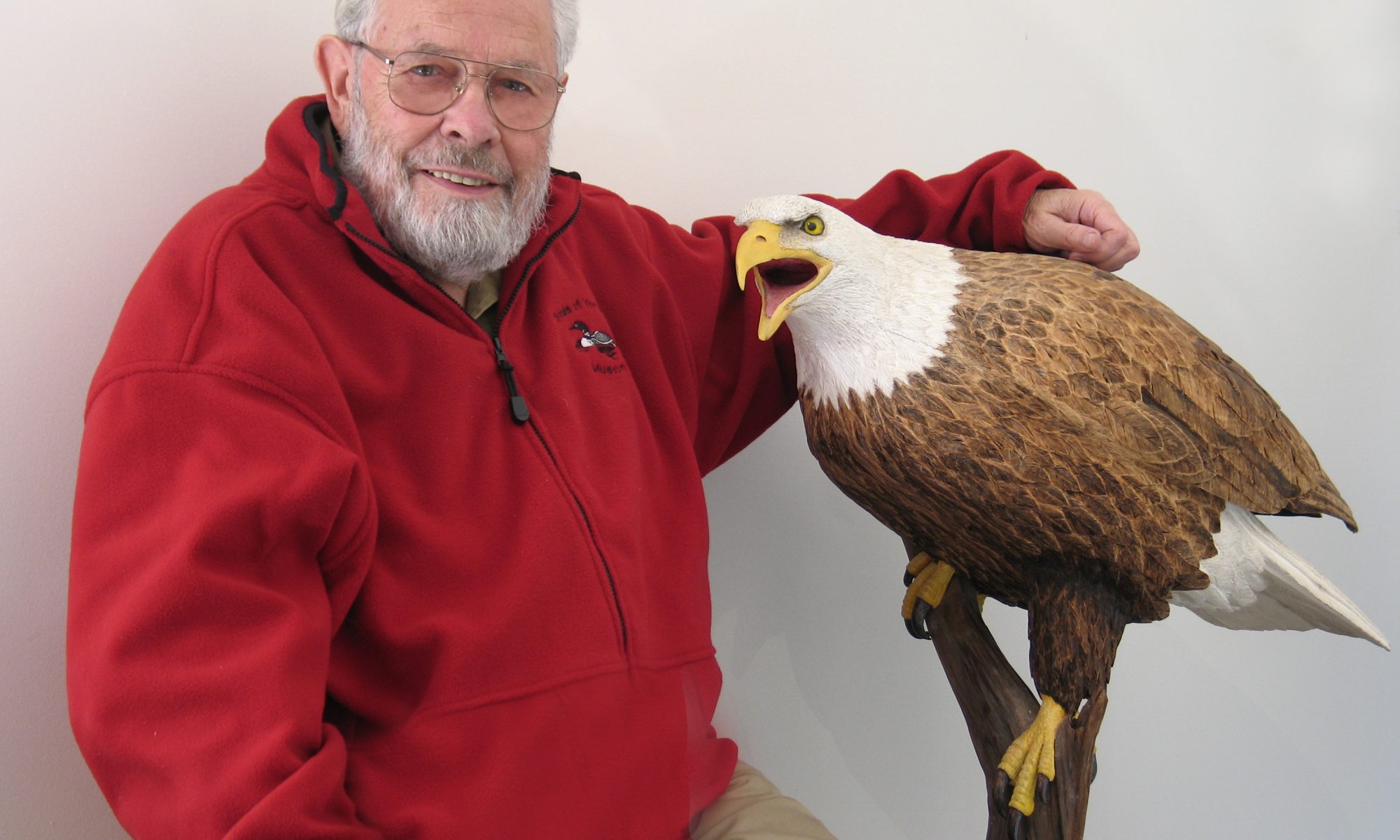
Bob Spear, Woodcarver, and his Bald Eagle carving: an elderly white mad with white hair and bear, wearing a red chamois shirt, faces the camera. His left arm rest on the back of a life-size bald eagle carved of wood.

Remembering Bob Spear

Naturalist, Birder, Carver, Teacher and More

 Loon mother and chicks, carved by Bob Spear Bob Spear. Photo by Caleb Kenna and used by permission. Black-capped chickadee on feeder; photo by Erin Talmage, 2010

On Saturday, October 25, the Birds of Vermont Museum will be open from 1pm – 4pm in the afternoon, in order to celebrate the life and legacy of Bob Spear. Please come and join us.

Bob Spear, our Founding Director, combined his lifelong love of birds and woodcarving into one of the most unusual conservation and education opportunities possible. We will have a chance to share memories, photos, conversation, and — because Bob loved it so — ice cream. The tree house and trails will be open also, and there are several places you might rest, contemplate, and observe birds.

Parking is limited, please carpool as much as possible. Audubon Vermont is graciously allowing visitors to use their parking lots as well.

Regular hours will resume on Sunday the 26th.

The family and the Museum are grateful and honored to read some of the comments and essays about Bob that have been published recently. A special thanks to Bryan Pfeiffer (http://bryanpfeiffer.com/2014/10/20/bob-spear-1920-2014/) and WCAX (http://www.wcax.com/story/26825578/vermont-naturalist-bob-spear-dead-at-94) for their kind words.

The Museum and staff can be reached by phone (802 434-2167), email (museum@birdsofvermont.org), and online (http://www.birdsofvermont.org).

Photos courtesy of Birds of Vermont Museum, Caleb Kenna Photography, and Erin Talmage.

Bob Spear, 1920 – 2014

Bob Spear: carver, naturalist, teracher, friend

Bob Spear: carver, naturalist, teracher, friendWe are saddened to announce that Bob Spear, friend, teacher, carver, naturalist, father, partner, and so much more, passed away on Sunday, October 19, 2014, surrounded by family and friends.

We at the Birds of Vermont Museum extend our deep condolences to everyone who knew him. We are and always will be grateful for all Bob shared with us: his passion for birds, his gift with wood, his constancy, persistence, dry humor, and deep knowledge.

We will pass on information about further arrangements when we learn of them.

You are welcome to call or write to us; we will pass messages to his family as well. Please stay in touch.

Erin Talmage, Executive Director
Shirley Johnson, Board of Trustees Chair
and the Museum Staff and Board members

We Remember

This post appeared first in our late summer 2014 issue of Chip Notes.

The fabric of the Museum’s history has been woven by many people. A few add a strand or two of color, while others provide the very warp that holds it all together. Unfortunately, there comes a time to say good-bye to some of these people. We are grateful for them, and we will miss them.

Ed Everts, 1919-2013

Ed Everts was a dear friend and instrumental in turning the Birds of Vermont Museum into a reality. He provided the initial funding that allowed Bob to start carving. Ed, and his partner Raven Davis, are remembered not only for their support, but also for their friendship.

In addition to all he did for the Museum, Ed was devoted to his family, spreading peace, working with the Peace and Justice Center , and exploring the world (sometimes with Bob and Gale in a VW microbus).

Mary B. Fell, 1920-2014

Mary Fell was a resident of Underhill. In addition to time spent volunteering for the historical society, she was a dedicated volunteer for Meals on Wheels and also volunteered many hours at Audubon Vermont‘s Sugar-on-Snow parties.

The General Assembly of Vermont wrote a resolution honoring her for her work. Her friend, Carol Wagner, is spearheading a campaign to dedicate a bench to Mary. The bench will be placed in the gardens along the path to the treehouse.

Hubert “Hub” Vogelmann, 1928-2013

Hub had personal ties with the Museum through his connections to Bob and Gale. He and his wife, Marie, were two of the Museum’s charter members. He had a close personal connection with the Museum’s mission of conservation. Hub worked with Bob and others to preserve Vermont ridgelines and mountaintops.

Hub was a botanist whose groundbreaking work on Camel’s Hump led to national attention regarding issues with acid-rain. He also co-founded Vermont’s chapter of the Nature Conservancy. In addition to serving on state and national environmental boards, he served on the Museum’s advisory board.


Carving Report: Late Summer 2014

This post, in a slightly different form, appeared first in our late summer 2014 issue of Chip Notes.

Learning to carve together

Carving, teaching about carving, and learning about carving continue to be at the forefront of the Museum’s activities.

Soap carving classes were held at local libraries and at the Museum this summer. We are always amazed what some people can do with a piece of soap. If you are online, look at our Pinterest board at http://www. pinterest.com/birdsofvermont/soap-carving/ for ideas.

In the past few months, Dave Tuttle of the Green Mountain Woodcarvers has taught three classes in which beginning and experienced carvers created first Wood Ducks, then Killdeer, and (in September) a black bear.

Comfort Bird by David Tuttle (Carved from trees downed by the July 2013 Flood)

Dave Tuttle has also carved “comfort birds” out of wood harvested from the flood-damaged area. These small carvings will be used as a thank you gifts to donors to Bridges to Birds.

Bob Spear has slowed down his carving, but on occasion we still hear him puttering about in his shop.

Board member Dick Allen recently finished the female Bufflehead. She joins the male, which he also carved, in the wetland diorama.